What's Good
A reflection tool that helps you move from raw language into clearer emotional language. Built to help you slow down, notice what you're feeling, and find better words for it.
What I noticed
We feel the whole spectrum of emotion, but a lot of us only carry a few words for it: mad, stressed, tired, good. So hurt gets called frustration, overwhelm becomes "I'm just tired," and everything else falls under "I'm good."
The problem
When every feeling gets translated into one or two words, you lose information about what's actually going on, and fewer words means fewer choices in how you respond. There's also the blank-page problem: journaling sounds good until you sit down and don't know where to start.
What I built
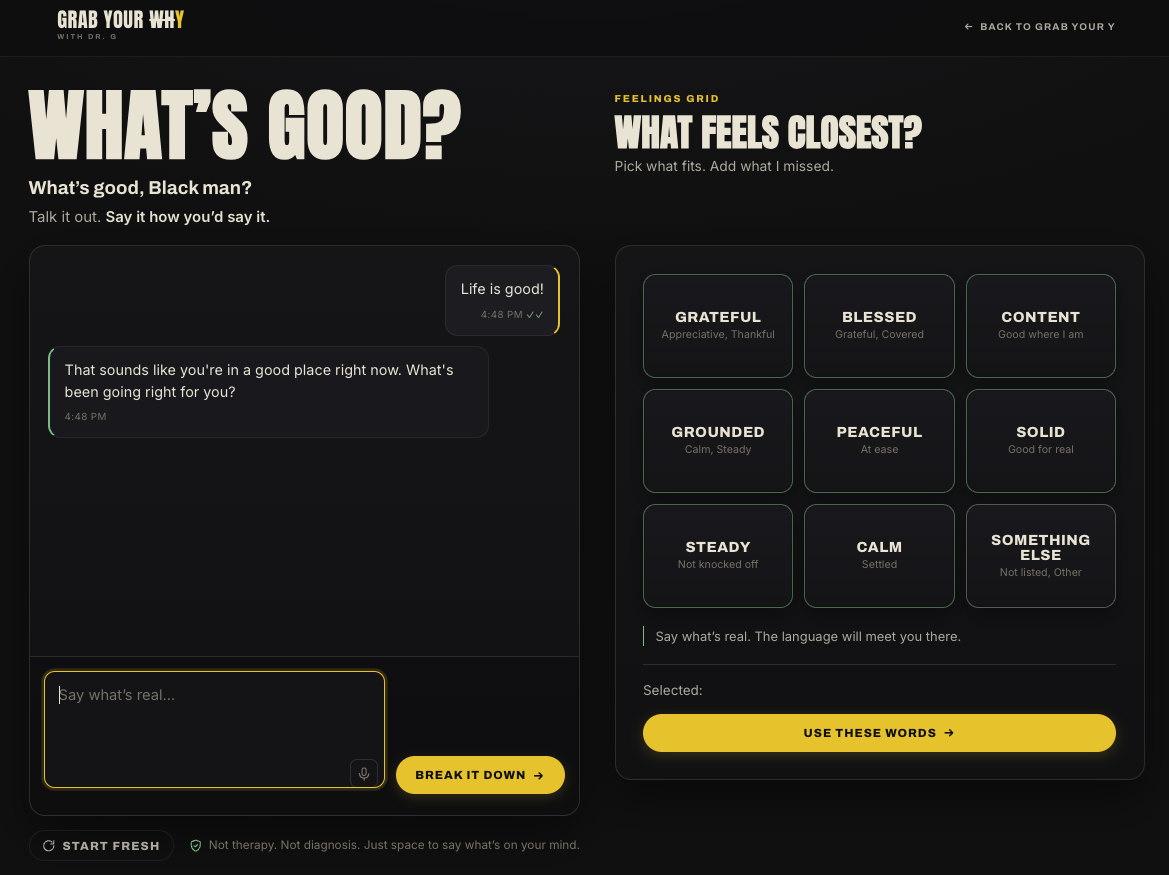
An AI-assisted reflection tool in the Grab Your Y universe. You start with a real doorway instead of a blank page, say what's on your mind, and it reflects back what it's hearing and surfaces feeling words that might fit underneath. It's a mirror, not therapy and not diagnosis.
The thinking behind it
Feelings are data, and the more accurate your language, the more choices you have. The restraint is the product: it reflects your experience without co-signing your conclusions, reading other people's minds, or telling you what to do. The goal is to help you slow down and notice, not to hand you advice.
How it works
- Pick a doorway or just type. Start with "What's good?", "What or who got me f****d up?", or "Help me start."
- It reflects what it hears and suggests feeling words, as chips on your phone or a live feelings grid on desktop that shifts with what you share.
- Choose the words that fit. It sharpens the reflection, asks one question, checks that it's landing, then offers a summary or a short takeaway to carry.
What I've learned / what's still being tested
Naming a feeling more precisely lowers reactivity, and the entry doors matter as much as the range of words. Ongoing work is about pacing, moving toward a summary without rushing or looping, widening the feelings vocabulary, and holding the restraint rules steady across messy, real conversations.